мне кажется, что со мной общаются как с местным деревенским дурачком, даже не столько из жалости, сколько из-за тупого, но тем не менее, пугающего взгляда исподлобья: мало ли прирежет
с одной стороны грамматические ашипки режут глаз, а с другой я не настолько душнила ущербная, чтобы поправлять людей в интернетах, а с одной ещё есть вечная зацикленность на тривиальной хуите, о которой я буду думать весь день
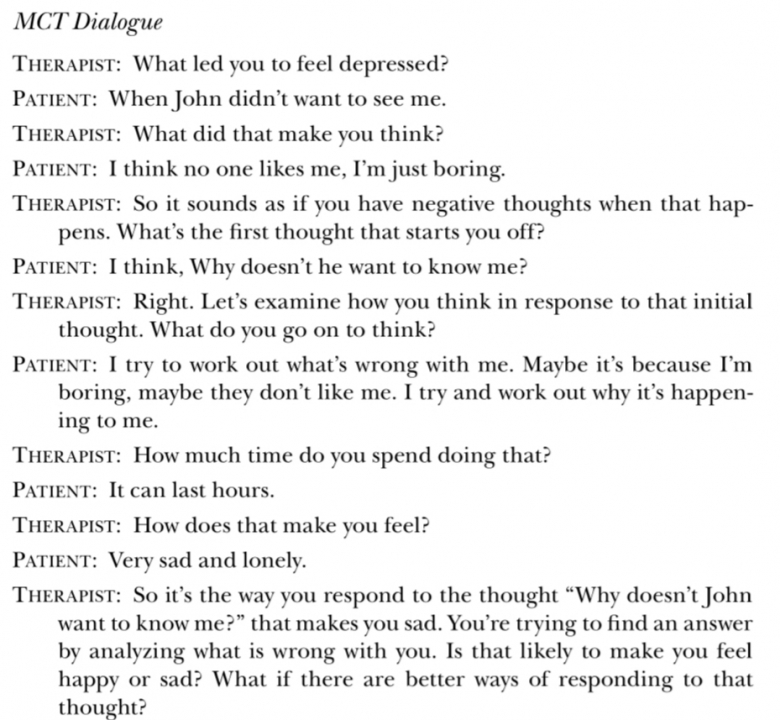
On the surface these beliefs may seem reasonable. However, in order to show their erroneous and distorted nature, they are repeated below with some useful questions that the metacognitive therapist uses to reframe them: “If I worry I will be prepared.” Is it possible to be prepared without worrying? Is it possible to worry about everything that could happen? Does worry give a balanced view of the future or a biased one? “Focusing on danger will keep me safe.” How do you know which danger to focus on? Is it the danger you see or the one you don’t see that will catch you out? Could focusing on danger make you less safe because you forget the usual things? “I must remember everything and then I’ll know if I’m to blame.” Is it possible to remember everything? How will knowing if you’re to blame help you feel better and move on? Can you move on without blaming yourself? “If I analyze why I feel this way I’ll find answers.” How long have you been doing this? How much longer will it take? What if the answer is stopping your analysis? What if there is no answer other than changing the way you think? “I must control my thoughts.” How do you know which ones to control? Is it possible to control all of your thoughts? Could controlling your thoughts stop you from finding out the truth about them?
At this juncture, before presenting any further detail, I believe that it may be useful to summarize the basic principles of the metacognitive approach: 1. It is proposed that the emotions of anxiety and sadness are basic internal signals of a discrepancy in self- regulation and of threats to well-being. 2. Such emotions are normally of limited duration because the person engages coping strategies to reduce threat and control cognition. 3. Psychological disorder results from the maintenance of emotional responses. 4. They are maintained because of the individual’s thinking style and strategies. 5. The unhelpful style, found in all disorders, is called the CAS, con-sisting of worry/rumination, threat monitoring, unhelpful thought control strategies, and other forms of behavior (e.g., avoidance) that prevent adaptive learning. 6. The CAS is the result of erroneous metacognitive beliefs (knowl-edge) controlling and interpreting thinking and feeling states. 7. The CAS prolongs and intensifies negative emotional experience through several clearly specified mechanisms/pathways.
чувствую себя мухой, бьющейся о стекло, когда я читаю чей-то длинопост на беоне, формулирую в голове мысль, которую отпишу в комментах, а комменты-то закрытые
“Postcoital dysphoria (PCD) refers to feelings that range from sadness to anxiety, agitation, anger — basically any bad feeling after sex that isn’t typically expected,” explains Gail Saltz, MD, associate professor of psychiatry at the NY Presbyterian Hospital Weill-Cornell School of Medicine.
It can even make you cry.
PCD can last anywhere from 5 minutes to 2 hours, and it can happen with or without an orgasm.
For example, one 2020 studyTrusted Source found that postcoital symptoms were present after consensual sex, as well as general sexual activity and masturbation.
Все тексты, изображения, видеозаписи и аудиозаписи на этой странице принадлежат пользователям.
Если вы хотите пожаловаться на содержимое этой страницы, пожалуйста напишите нам.

 Дневники
 Тесты
Тесты
 Сообщества
 Альбомы


 65
65
 8
8